
June 8, 2026

Content
What Is Cell Line Development and Why Does It Matter?
How Cell Line Development Works: From Gene to Stable Clone
Complex Molecules Need Tailored Approaches
Quality, Compliance, and Long-Term Cell Line Stewardship
What to Look for in a CLD Partner
Every biologic begins with a single cell. One that has been engineered, selected, and characterized to become the production system for a drug. That process is cell line development, and it determines the program’s manufacturing economics, product quality profile, and regulatory baseline before anything else is built on top of it. The productivity and product quality profile of a production cell line have a substantial impact on manufacturing costs and, ultimately, the success of a product. Certain product quality attributes can also influence pharmacokinetics, potency, and patient safety, which is why regulators look at them closely. Scalability brings its own constraints. It’s pointless to achieve high titers and ideal product quality at small scale if this cannot be translated to manufacturing scale. A suboptimal cell line won’t improve at larger scale, where robust process consistency must be demonstrated. That is why cell line development is a scientific milestone and an early manufacturing and regulatory decision. The choices made here shape everything that follows. So let´s dive a bit deeper into this topic.
What Is Cell Line Development and Why Does It Matter?
Cell Line Development (CLD) is the process of engineering and selecting a cell to stably produce a biologic at commercially relevant titers and with the product quality attributes required for clinical and commercial manufacturing. It typically encompasses delivery and stable integration of the expression vectors, generation of cell pools expressing the target genes, single-cell cloning, and systematic clone screening to identify a lead production clone that meets defined productivity, quality, and stability criteria.
For recombinant biotherapeutics, this most often means CHO (Chinese hamster ovary) cells: they grow well in suspension, scale predictably to large bioreactors, produce human-compatible N-glycosylation patterns, and carry decades of regulatory precedent. But CHO is a starting point, not a shortcut. The host strain, transgene integration method, selection strategy, and quality of analytical characterization throughout development all shape the cell line that comes out at the end. ProBioGen's CHO.RiGHT® platform was built and refined over decades of CLD work to treat each of these variables as a coherent integrated system, not a checklist.
Demand for CLD services is rising as the biologics pipeline grows more complex. Multi-chain formats like bispecific antibodies, biosimilars, and gene therapy vectors each bring challenges that a standardized workflow will not always resolve.
What Makes a Great Cell Line?
Lead clone selection is not a single-metric call. Productivity, stability, and product quality must be assessed in parallel, and the relationship between them is where most of the real CLD decision-making happens.
High Productivity and Stability
High productivity is a key driver in enabling cost-efficient manufacturing processes. However, titer alone does not make a lead clone. A producer clone must maintain stable expression and consistent performance over extended passaging, from thawing a vial from the master or working cell bank through to production at commercial scale. This ensures a consistent product quality profile, which must be demonstrated to regulatory authorities, as it may impact patient safety.
The challenge is that stable expression cannot be taken for granted. Instability most commonly arises from transgene silencing or genomic rearrangements, and the risk is significantly higher when the expression strategy relies on random integration into the host genome. Site-specific or transposase-based integration can improve stability, which is one of the reasons why these approaches are now more widely adopted.
ProBioGen’s unique DirectedLuck® transposase goes one step further. It specifically targets epigenetic marks and directs transgenes to integration sites with the highest transcriptional activity and epigenetic stability. This approach enables highly consistent expression and minimizes the risk of stability issues.
Top Product Quality
Getting the glycosylation profile, charge variants, and aggregation tendency right is not just a quality assurance exercise. These attributes directly shape how the drug performs in patients.
For antibodies, both the glycan pattern on the Fc region and amino acid mutations within the Fc sequence influence effector function. At the cell line level, glycosylation — and core fucosylation in particular — is the primary controllable lever: reduced fucosylation enhances antibody-dependent cellular cytotoxicity (ADCC) activity, a principle ProBioGen has built into its GlymaxX® glycoengineering platform, which enables production of afucosylated antibodies and antibodies with precisely controlled fucosylation levels. But it is more than just the glycans. Charge variant control and aggregation management are part of the same quality picture and can be addressed through deliberate cell line and process choices. Both carry further implications for stability, potency, and safety.
While some of these attributes can be sequence-inherent, the majority are significantly shaped by the cell line, the culture process, and the rigor of quality monitoring throughout development. Leaving quality assessment until the end of CLD is too late to meaningfully act on what it tells you.
For more complex formats, additional quality attributes come into play. Heterodimer content in bispecifics, high-mannose glycan levels (Man5), and truncated protein species are all influenced by cell line selection and culture conditions, and all need to be tracked from the start, not flagged at the end.
Confirmed Clonality
Production cell lines must originate from a single progenitor cell. This requires robust evidence and documentation of single-cell derivation, commonly supported by imaging, along with appropriate molecular characterization aligned with the regulatory strategy.
How Cell Line Development Works: From Gene to Stable Clone
Timelines greatly depend on a molecule’s complexity and on how many variants of a molecule are developed in parallel. For standard antibodies, modern workflows are compressed and accelerated. ProBioGen’s CHO.RiGHT® platform enables cell line development from gene to fully characterized research cell bank (RCB) within 15-18 weeks. This includes a fed-batch bioreactor performance assessment before final clone selection, a step not all platforms include.
Gene Insertion and Initial Selection
The gene construct is introduced into CHO host cells by transfection. The choice of integration method carries consequences through every subsequent step. Transposase-based systems direct the transgene to transcriptionally active genomic regions and generate a more consistent starting population than random integration approaches. After transfection, selection pressure removes non-expressing cells, generating a polyclonal bulk pool. Characterizing this pool early provides useful data on expression and product quality before significant resources are committed to single-cell cloning and clone screening. A pool with a favorable product quality profile increases the likelihood of identifying clones that meet both titer and quality targets, which is relevant particularly when more than one critical quality attribute needs to be addressed. Well-characterized pools can also supply material for early development and toxicology work, shortening time to first-in-human.
Single-Cell Cloning, Automated Clone Screening and Lead Selection
Single-cell cloning generates individual clonal lines, each traceable to a single cell, screened for titer, growth, product quality, and stability. Where applied, next-generation sequencing (NGS) data can be incorporated on integration site, copy number, and sequence integrity to support final lead selection, producing a small number of well-characterized candidates for cell banking and formal stability studies.
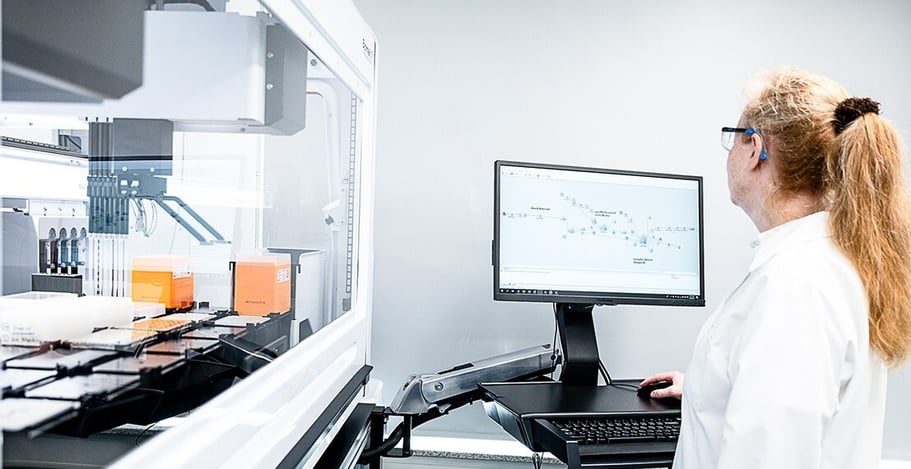
How many clones you screen, and how well you characterize them, determines what ends up in the bank. Manual workflows limit both — not just in throughput, but in the quality of the data behind each clone decision. ProBioGen’s unique PsiBot system, one of the most advanced platforms for automated clone screening, addresses this directly. Confident clone decisions are powered by a fed-batch that mirrors larger processes with unexpected precision. Its broad analytical options enable screening of hundreds of clones, identifying those with the highest product quality much earlier, and accelerating overall timelines in the process. You can read more here about how smart automation is redefining CLD.
Complex Molecules Need Tailored Approaches
Standard monoclonal antibody workflows are well-established, but much of today's pipeline goes beyond them. Each molecule class brings specific challenges at the cell line level that a generalized approach will not always capture.
For a broader look at how cell line development connects to upstream processing, purification, formulation, and GMP manufacturing, read our blog Gene to GMP: Navigating mAb Development and Manufacturing From Cell Line to Drug Product.
The CLD Decision Is Also a CMC Strategy Decision
CLD is a foundational component of Chemistry, Manufacturing and Controls (CMC) strategy, applicable across both protein therapeutics and viral vector programs. Decisions made at this stage shape what comes next: process development, analytics, GMP readiness, and technology transfer. Getting the CMC strategy right at the outset is one of the most consequential decisions a development team will make.
 While the importance of early CMC decisions is clear, not every program requires the same approach. Program stage, timelines, internal capabilities, and strategic priorities shape the right CMC path. To bring more clarity to these different realities, ProBioGen developed CMC Navigator™ — a structured framework for protein CMC collaboration. It provides four service models, Sprint, Scale, Customize, and Rise, that help teams align early on scope and execution, based on real program situations.
-
Sprint model is designed to accelerate early clinical supply when first-in-human timelines are the priority, following a clearly defined, platform-based path.
-
Scale is built for programs that need near-term clinical supply while preparing for what comes next, including scalability, documentation, and transfer readiness.
-
Customize is a modular option for stand-alone CMC work packages within an existing strategy.
-
Rise is intended for clinical-stage programs that need to strengthen an existing asset by improving cell line and process performance without restarting.
Quality, Compliance, and Long-Term Cell Line Stewardship
A cell line that cannot support a regulatory filing is not complete. GMP-aligned documentation practices must be part of the CLD process from day one. Regulatory agencies expect clonal derivation records, sequence verification, expression characterization, and multi-generational expression stability data as part of IND, Investigational Medicinal Product Dossier (IMPD), BLA, and MAA submissions.
Cell banking follows lead clone selection, producing Research, Master, and Working Cell Banks in line with applicable guidance and internal quality systems, including principles described in ICH Q5D. All these steps keep the cell line as a protected, well-documented asset for the full commercial life of the product.
What to Look for in a CLD Partner
The cell line your CLD partner produces is the foundation of everything built on top of it.
“Cell line development is where manufacturability gets decided early. When you combine a proven platform, integrated analytics, and close scientific collaboration, you can move confidently toward the clinic with the highest-quality cell line and full confidence in your process.”
- Dr. Thomas Rose, Head of Expression Systems at ProBioGen
The right CLD partner integrates cell line development and product quality assessment as a single continuous workflow. CLD and product quality teams that work in close alignment ensure that critical data is captured and acted on at the moment it matters most, before irreversible commitments are made.
Both NGS capability and high-throughput screening add measurable value to every program and can make a real difference in the outcome.
Track record with your specific molecule format is worth investigating properly. Capability and experience with bispecifics, biosimilars, single-chain constructs, and viral vectors vary considerably. Ask for specific examples and data.
ProBioGen has been developing production cell lines for sponsors across the global biopharma industry for decades. The CHO.RiGHT® platform is built around the DirectedLuck® transposase, proprietary expression vectors, an optimized CHO-DG44 host, and a chemically defined process medium. Together these components deliver consistent high productivity, outstanding stability, and well-controlled product quality attributes. For programs requiring enhanced effector function, GlymaxX®, ProBioGen’s glycoengineering platform for Fc afucosylation, enables the production of antibodies with significantly elevated ADCC activity.
Combined with PsiBot, the workflow advances only the most promising candidates, faster and with greater confidence. These capabilities are applied across a range of molecule formats, including standard IgGs, complex bispecifics, biosimilars, and other modalities.
Conclusion
Cell line development is a foundational commitment. The cell line selected here sets manufacturing parameters, quality profile, and regulatory baseline for the entire life of the program. Treating it as a formality to move through quickly can turn out to be one of the costliest mistakes a development team can make.
The science available today is genuinely powerful. A transposase-based approach, smart high-throughput clone screening, NGS-based characterization, and rigorous analytical integration make it possible to build a production cell line with a level of confidence and speed that was not realistic a decade ago. What converts that science into a reliable outcome is experienced scientific ownership, and genuine commitment and passion for getting it right, at every step.
For a deeper look at why specialized CDMOs are designed to integrate across the CMC value chain, avoid siloed execution, and combine proven platforms with customization, read one of our latest blogs Tailored by Design: How Specialized CDMOs Lend an Edge to Your Drug Development Project.
Talk to Our CLD Team
If you are evaluating cell line development options for your program, get in touch with the ProBioGen team.