
November 27, 2026
Content
A Natural Expansion into Advanced Therapies
Designing for Flexibility, Building at Speed
Connecting Capabilities Across Modalities
From Design to Manufacturing Readiness
In 2025 ProBioGen was selected to design, build and operate the GMP manufacturing facility at the Berlin Center for Gene and Cell Therapies (BC GCT). More than one year into the project, that mandate is moving decisively from design into execution. Core manufacturing concepts and equipment requirements have been defined, construction is progressing, and a dedicated project organization is in place. In parallel, ProBioGen is expanding the scientific, operational and commercial capabilities needed to support cell and gene therapy (CGT) programs alongside its established work in proteins, antibodies, viral vectors and vaccines.
The BC GCT, however, is only one part of a broader ProBioGen story. The project adds another manufacturing location in Berlin, extends the company’s service offering into cell-based products and strengthens its role as a specialist, multimodality CDMO. One year in, four members of ProBioGen's dedicated project team closely involved in the BC GCT's GMP manufacturing facility project reflect on how that expansion is taking shape — from strategic direction and facility design to alliance management and the opportunities it creates for future clients.
A Natural Expansion into Advanced Therapies
Dr. Alfred Merz, ProBioGen’s Chief Executive Officer, sees the expansion into advanced therapies as a natural development of the company’s established strengths in therapeutic proteins, antibodies, viral vectors and vaccines. “This is about where we want to take ProBioGen next. We are adding a new pillar alongside our established work in proteins and viral vectors, extending our expertise into therapies where the cell itself becomes the product. It gives us the opportunity to combine our scientific depth across different modalities and support increasingly complex therapies in a more integrated way.”
The strategic logic is grounded in capabilities that are already part of ProBioGen today: cell line and process development, viral vector technologies, analytics and GMP manufacturing. The BC GCT brings innovation, development and manufacturing, in closer proximity, supported by the clinical and regulatory expertise of the Berlin Institute of Health (BIH) and Charité – Universitätsmedizin Berlin. This creates an environment in which promising programs can engage with manufacturing expertise earlier on the path toward clinical application.

The BC GCT also addresses a broader challenge in Germany: while the country has outstanding scientific and medical excellence, as well as clinical expertise, too few promising ideas make the transition into industrial stages and commercial success. Limited access to private capital remains an important part of this challenge, particularly for early-stage companies. By bringing together these key elements and expertise, the Center may also serve as a guide for venture capital to invest into resident start-ups.
“Every clinical candidate development program is different. We work closely with our clients and adapt to the specific needs of each project. The BC GCT gives us the environment to bring that same specialist and customer-first approach into advanced therapies.”
For ProBioGen, the significance therefore goes beyond adding another service area. It brings an established way of working — deep scientific involvement, close collaboration and a solutions-oriented approach shaped around individual programs — into new kinds of modalities. That strategic ambition is taking shape in the planning and construction of a facility designed to support diverse advanced therapy medicinal product (ATMP) processes.
Designing for Flexibility, Building at Speed
As Project Lead, Andreas Jösslin is responsible for the planning and construction of ProBioGen’s new GMP facility at the BC GCT and represents the company in planning discussions and on site. He sees his role as steering the project, listening and bringing people together.
“Our focus has been to develop the layout for a future-oriented, flexible and multifunctional GMP facility and translate it into execution,” Jösslin says. “At the same time, we needed to establish a stable internal organization, foster team spirit and interdisciplinary collaboration, and present ProBioGen externally as a competent and collaborative partner — while keeping the goal and the path to it clear to everyone involved.”
The flexibility has shaped key design decisions. “The future site has to accommodate a broad range of gene and cell therapies through clinical Phase II and remain flexible enough to adapt to market developments,” Jösslin explains. “That has shaped our focus on different hygiene regimes, utility and media supply, digitalization and the technical infrastructure.”
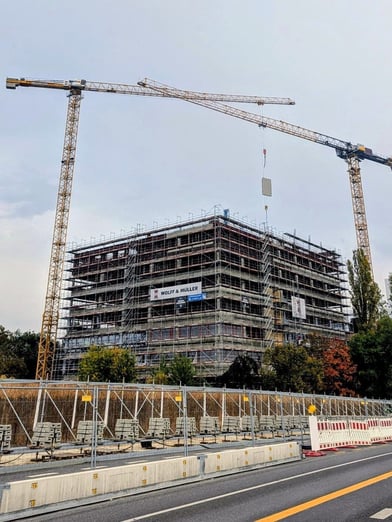 The project has moved quickly. Design planning began in October 2025, and the layout was completed by the end of January 2026. ProBioGen has combined an experienced planning team with extensive in-house expertise from across the organization, and all planning milestones have been met to date. Jösslin credits that progress to the way the project team is working. “None of this would be possible without a highly motivated, technically competent team working together in an integrated and collaborative way.”
Qualification will be critical in demonstrating that the facility’s rooms, technical systems and equipment meet GMP requirements and perform as intended.
“Qualification is complex because many different areas have to come together. We need to demonstrate that the rooms, technical systems and equipment meet GMP requirements and perform as required for our processes,” Jösslin explains. “That creates the foundation for manufacturing products to high-quality standards in the future.”
Jösslin points to several first-year achievements he is particularly proud of. These include the continued optimization of the facility layout and the flexibility built into the design which also preserves options for future adaptation as manufacturing requirements evolve.
Together, these results show how early planning is already translating into greater flexibility and future options for the facility.

A New Partnership Model
Dr. Christoph Giese, Director Cellular Therapy & Analytics and Project Alliance Manager at ProBioGen, has been involved in the BC GCT from the original call for proposals. Alongside alliance management, he brings extensive subject-matter expertise in cell culture across process development, manufacturing and analytics.
ProBioGen’s decision to enter the field followed years of assessing both the scientific development of cell and gene therapies and the market around them. For Dr. Giese, the turning point was clear: “The breakthrough success of CAR-T therapies, together with the increasing maturity of the field, made this the right time for ProBioGen to take this step. I was one of the strong advocates, and I’m proud that we have taken it.”
After winning the Europe-wide public tender to design, build and operate the GMP facility in 2025, ProBioGen's role within the partnership has grown with the project. “Our role within the consortium has grown as the project has progressed. Today, we contribute our project-management expertise in facility design and construction alongside our experience in GMP operations.” Once operational, ProBioGen’s role will include clinical manufacturing for a broad range of cell and gene therapy modalities, including those emerging from the BC GCT incubator.

Giese’s alliance-management role also reflects the distinctive structure of the BC GCT. The initiative brings together partners from academia, healthcare and industry within a publicly funded framework, each contributing different perspectives, expertise and responsibilities into the project. At the same time, the facility is being designed to accommodate different ATMP modalities and remain adaptable as the field evolves.
“We need to design the laboratory and GMP environment so that it remains open and flexible. That is the only way we can respond to the needs of the start-ups, operate the facility efficiently and adapt to future medical, scientific and clinical developments.” CAR-T cells and lentiviral vectors provide a practical starting point for the facility, maintaining flexibility for additional modalities as needs evolve.
For him one of the clearest lessons from the first year has been about the partnership itself. “Many partners are involved, bringing different perspectives and responsibilities to the project,” Giese says. “That makes balanced communication and involving the relevant decision-makers early especially important.” The experience has reinforced the importance of careful preparation and stakeholder alignment in a project that brings together public and private partners with different perspectives and responsibilities.
For Giese, that alignment is an essential part of preparing the future operation, alongside the technical and GMP work itself.
Connecting Capabilities Across Modalities
Dr. Michiel Stork, Vice President Business Development, focuses on where the future GMP facility can add value for both the BC GCT incubator companies and external developers — and at what stage ProBioGen can best support their programs.
“The translation from a lab-bench experiment to a product candidate that is fully GMP compliant and ready to be tested in humans is where we come in,” Dr. Stork says. “Sometimes that starts very early, for example by helping to design a viral vector and shape the project. In other cases, we come in during process development or closer to the GMP stage. It depends on what the program needs.”
For Stork, available manufacturing capacity by itself is not what sets ProBioGen apart. In his view that is the ability to support multiple ATMP modalities and connect scientific expertise, process development, analytics and GMP know-how across them. Within the BC GCT, the proximity of Incubator residents and our GMP Factory can help developers understand sooner what GMP-compliant development requires and avoid having to repeat work later. Funding remains a separate challenge. Stork regularly speaks with companies that have strong ideas and early proof of concept but struggle to move into development because of financial constraints. An experienced CDMO cannot solve that funding challenge, but it can help remove technical and process obstacles along the way.

The commercial value of multimodality becomes clearest where technologies meet. For cell and gene therapy programs that use a viral vector, the connection can be direct. “If a viral vector is part of the therapy, we can connect vector development and manufacturing with the subsequent cell processing steps.”, Stork explains. “The client does not have to move the program from one CDMO to another, allowing key development and manufacturing steps to remain closely connected within Berlin.”
The connection also reaches back into ProBioGen’s long-standing cell line development expertise, which is already being applied to stable pools and cell lines for lentiviral vector production. As Stork puts it, “Having more than one modality strengthens all of our workstreams. We can take knowledge and technologies developed in one area and apply them in another.”
Looking ahead, he is particularly drawn to the possibility of supporting programs more continuously — from lentiviral vectors and AAV through the handling of all kinds of therapeutical cellular products, and from early development toward clinical manufacturing.
“What excites me most is being able to support clients end to end and to work closely with the start-ups and incubator companies as they move their products toward the clinic. There are many indications and rare diseases where cell and gene therapy has the potential to make a real difference for patients.” That promise already extends well beyond blood cancers such as leukemia to solid tumors and autoimmune disease, with rare diseases increasingly becoming a target for AAV-based gene therapy as well.
For Stork, the value is therefore practical: connecting expertise across modalities so that clients can move through development with fewer handovers and a more continuous path toward GMP manufacturing.
BC GCT | ProBioGen GMP Facility at a Glance
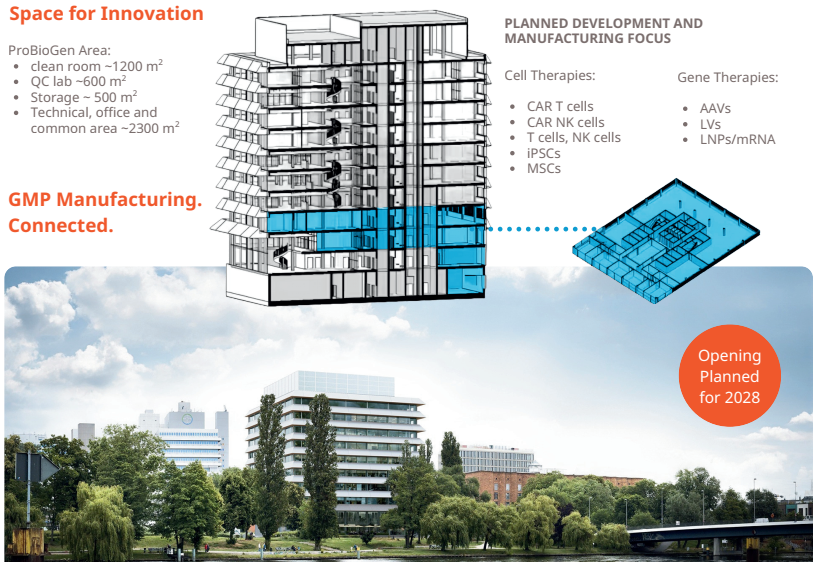
The ProBioGen-operated GMP facility will be an integral part of the BC GCT, a joint project of Charité – Universitätsmedizin Berlin, the Berlin Institute of Health (BIH) at Charité, and Bayer AG, supported by federal and state funding.
From Design to Manufacturing Readiness
A recent milestone already points in that direction: in October 2026, BIH and ProBioGen reached a milestone when the first section of the future GMP facility was officially handed over by iQ spaces. Laboratory spaces for the quality control of gene and cell therapy products are being set up there, alongside the necessary technical infrastructure — in particular, the ventilation system for the cleanroom facility.
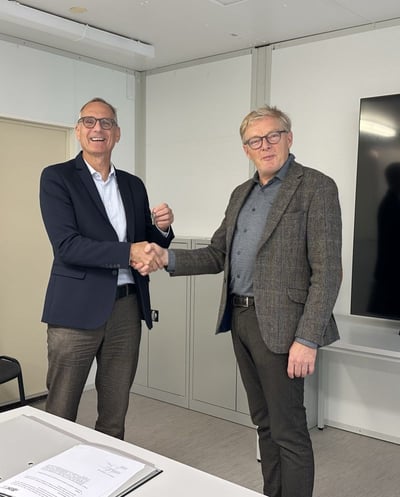 Prof. Dr. Christopher Baum, Chair of the BIH Board of Directors, and Dr. Alfred Merz, CEO of ProBioGen, sealed these next steps with their signatures. The project continues to be supported by €76.5 million in federal funding from the BMFTR over the next ten years.
As the building construction progresses, 2027 will bring the facility visibly closer to operation: the cleanroom facility will take shape, and initial process equipment will be defined. In parallel, process-development and viral vector manufacturing and activities can already be supported at ProBioGen’s existing Berlin facilities. Dedicated project and business-development resources are in place, while scientific capabilities for future cell-therapy programs continue to expand.
One year into the project, the significance of the BC GCT is becoming increasingly tangible. For ProBioGen, the ambition is not simply to bring a new facility into operation, but to establish advanced therapies as a complementary part of its business alongside proteins and viral vectors — supported by the same scientific depth, GMP expertise and close collaboration that underpin its work today.
“The GMP facility is only the starting point. The real measure of success will be the programs we help advance, the developers we support on the path to the clinic and, ultimately, the therapies that reach patients. That is the future we want to help build.” concludes Dr. Alfred Merz.
Talk to Our Team
Exploring a cell or gene therapy program and wondering where GMP manufacturing fits into your development path? Talk to our team about how ProBioGen’s growing advanced therapy capabilities — from early process development to the future BC GCT GMP facility — can support your program.