Developability Assessment
Are your selected lead candidates stable, soluble, and robust enough to make it to the clinic?
ProBioGen's developability assessment platform measures the molecular properties and stress responses that drive aggregation, particle formation and formulation risk—revealing your candidate’s comprehensive developability profile. Orthogonal data support candidate selection, identify critical liabilities, and help define the next development step before significant material, time, and resources are committed to advancing the candidate.
De-Risk Your Lead Candidate With Early Insights
Developability failures often emerge during the purification, concentration, storage or handling of a biologic candidate, at a point when starting over is both costly and time-intensive. Our platform directly tests candidates under relevant solution and stress conditions, providing critical insights early and de-risking the path from candidate to clinic.
Conformational stability, colloidal stability, aggregation, fragmentation, charge heterogeneity, subvisible particles, solubility, self-interaction and viscosity are assessed using orthogonal methods. Forced degradation studies reveal sensitivity to temperature, agitation, freeze-thaw, oxidation and pH. For multiple candidates, predefined criteria enable transparent ranking. The result is a comprehensive experimental risk profile with clear recommendations for candidate selection, formulation work, and further development.

Tailored to Your Molecule
Methods, stress conditions, and decision criteria are selected for the molecular format, development stage, intended product profile and available material.
From R&D to GMP
Developability assessments are performed in a controlled R&D environment using documented procedures. Methods and results can be transferred into ProBioGen's GMP analytical and stability workflows when required.
One-Stop-Shop
The assessment can be applied directly to formulation development, analytical development, bioassays, stability studies, process development and GMP manufacturing, all under one roof at ProBioGen.
Integrated Team Work
Biophysics, formulation, analytics, DSP and bioassay experts jointly define the study and interpret the complete dataset.What We Offer
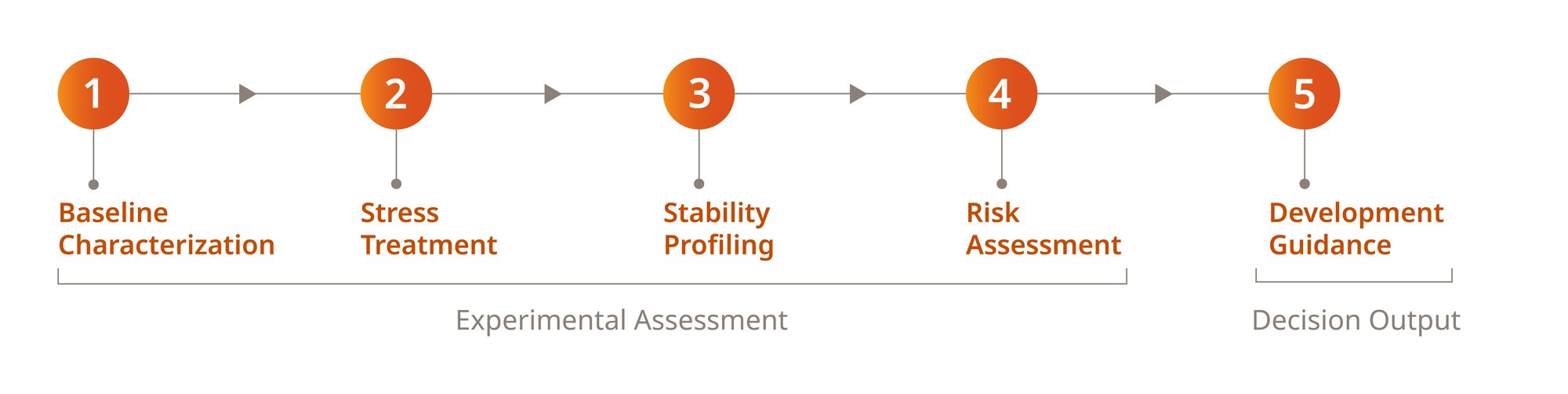
Establishes the initial quality and stability profile. Typical readouts include SE-HPLC, CE-SDS, icIEF, nanoDSF, DLS, subvisible particle analysis and protein concentration.
Measures thermal unfolding, aggregation onset, size distribution, polydispersity and self-interaction. Combined readouts distinguish structural from solution-related instability.
Tests sensitivity to elevated temperature, agitation, freeze-thaw, oxidation and low or high pH. Stability-indicating methods identify the dominant degradation pathways.
Quantifies soluble aggregates and subvisible particles across relevant size ranges. Results identify handling and formulation conditions that promote particle formation.
Determines concentration limits and concentration-dependent changes in turbidity, self-interaction, viscosity and aggregation. The scope is adapted to the intended dose and route of administration.
Compares defined pH, buffer, ionic-strength, excipient and surfactant conditions. Promising conditions are selected using orthogonal stability data and, where appropriate, Design of Experiments.
Applies predefined, program-specific criteria across all measured attributes. Candidates are ranked by overall risk, with critical trade-offs shown explicitly.
Experimental Developability Workflow

Our Promise To You
Confidence in Candidate Decisions
- Early visibility of critical developability liabilities
- Transparent ranking across multiple candidates
Evidence Specific to Your Molecule
- Study design matched to molecule, stage and product profile
- Testing under relevant solution and stress conditions
Clear Development Recommendations
- Guidance for candidate selection and formulation strategy
- Findings that inform further development decision